- A bang is a sound; water hammer is a particular pressure response to changing flow.
- The operating valve and place where movement becomes audible can be different locations.
- A steady pressure reading and a captured event answer different questions.
- Use ordinary-use records, then ask the plumber for finding-linked work and clear follow-up.
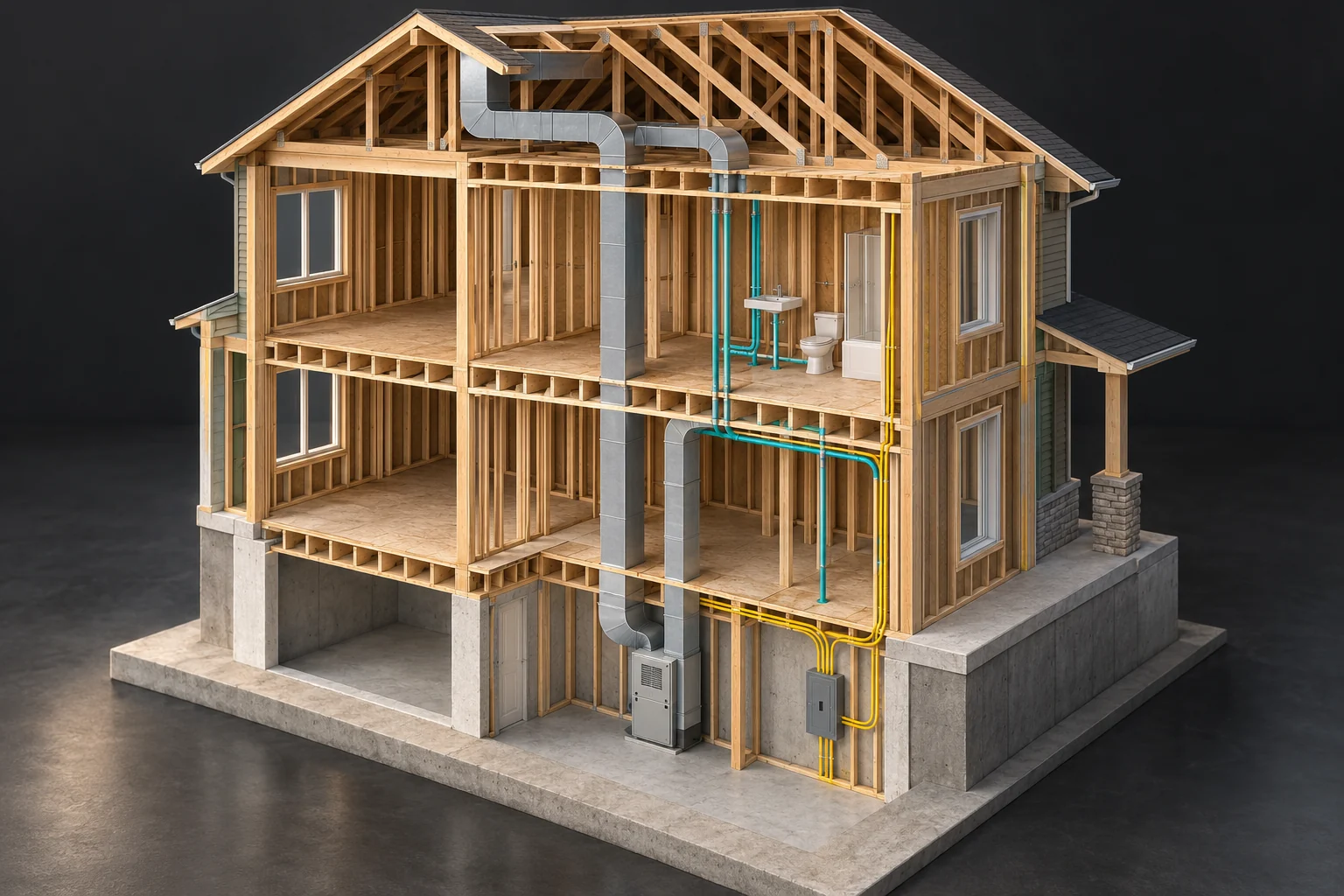
Conceptual architecture. Layout, sizes and routes are illustrative; the picture does not describe your home’s condition.
Explore this in the visual atlas ↗4 picture lessons appear beside the questions in this guide. Use them to understand the explanation, then consider what it means for your home.
Is every pipe bang water hammer?
No. Water hammer is a brief pressure response when flowing water changes motion. A bang is the sound you hear. A washer stopping its fill, a pipe touching framing and a heating pipe warming can lead to different questions. Describe the normal activity and timing before naming the cause.
Identify the pipe’s job if it is known. A supply pipe brings pressurised water to a fixture. A drain carries used water away. A water-based heating loop circulates through heating equipment. A sound near one visible pipe does not establish which connected route generated it.
The explanation starts with familiar parts: water moves through a pipe, a valve changes the passage and the connected system responds. That response can involve pressure and movement. A sound recording alone cannot tell you the pressure involved, whether a component has failed or where concealed movement occurs.
An active leak, loss of service or equipment distress needs its own immediate service response. Keep clear of water near electrical equipment and obtain the appropriate help. This guide explains an ordinary noise investigation; it does not declare a noisy installation safe or ask you to reproduce a concerning event.
What changes when a valve closes?
While a washer fills, water is moving through its supply route. A valve controls the available passage. A rapid change in that passage can change water motion abruptly, producing a pressure disturbance in the connected water and pipe. The moving water and the pipe respond together.
Water has a small ability to compress, and pipes have some elasticity: they can deform and recover under load. These properties matter to the response. Hayward’s engineering sheet explains the combined liquid-and-pipe behaviour. Its industrial examples do not provide a pressure calculation or a safe operating limit for your home.
Follow the sequence rather than imagining a solid lump of water crashing through the pipe: water is moving, the valve changes the passage, and a pressure response travels through the connected arrangement. Our conceptual diagram shows these roles without assigning a wave speed, spike height or event duration.
A new thump after appliance work is useful timing information. It does not, by itself, prove the appliance caused a defect. Ask the plumber how the actual valve, supply route and operating event fit together, and what observation or measurement is needed to assess that relationship.
Moving water, a changing passage and a pressure response
The sequence explains how a change in water motion can produce a pressure response in the connected arrangement.
Numbers identify the parts explained below.
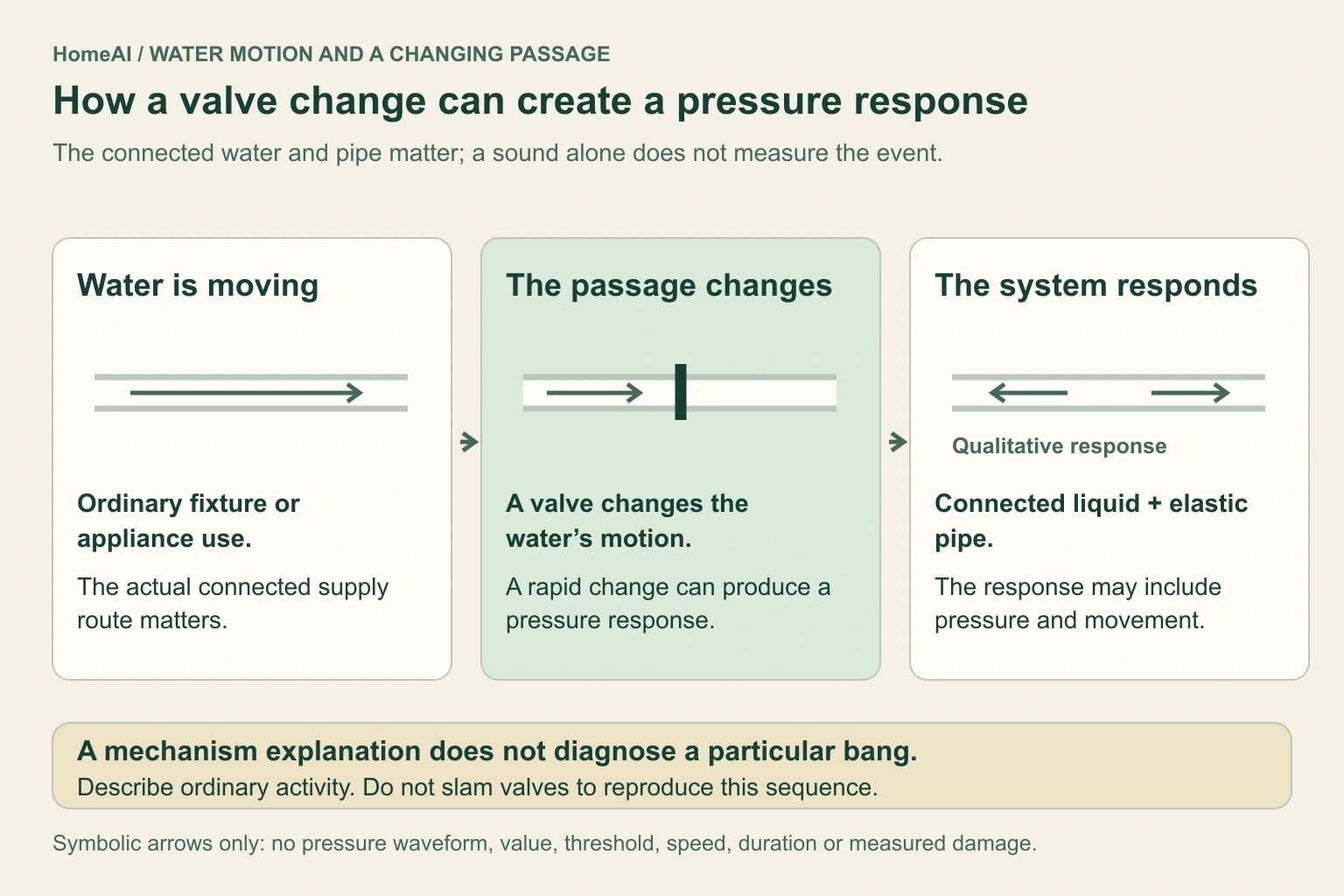
- Water is moving
A supply route carries water during an ordinary appliance or fixture activity. The actual connected route matters.
- Valve changes the passage
A rapid valve change can alter water motion abruptly. Do not deliberately create this event for an owner investigation.
- Water and pipe respond
The connected liquid and elastic pipe can experience a pressure response and movement. This conceptual sequence supplies no spike height, wave speed or measured damage.
What does this illustration leave out?
It does not establish that a recorded sound is water hammer or measure its magnitude. Ask how the actual route and event were assessed. Qualitative mechanism only. The panels are not a pressure trace or installation instruction; do not slam a valve to reproduce them.
What ordinary event and connected route does the professional’s assessment actually establish?
Explore this with HomeAI ↗Opens an editable question. Nothing is sent until you choose to send it.Read the complete picture lesson
Moving water, a changing passage and a pressure response
Flowing water has momentum. A rapid change in the valve passage can change that motion and produce a pressure response in the connected liquid and pipe. Water’s compressibility and pipe elasticity are part of the response.
- Water is moving
- A supply route carries water during an ordinary appliance or fixture activity. The actual connected route matters.
- Valve changes the passage
- A rapid valve change can alter water motion abruptly. Do not deliberately create this event for an owner investigation.
- Water and pipe respond
- The connected liquid and elastic pipe can experience a pressure response and movement. This conceptual sequence supplies no spike height, wave speed or measured damage.
This is a qualitative mechanism, using manufacturer engineering explanations within their scope. No industrial equation, velocity limit or household pressure threshold is imported. Describe normal activity to the plumber; do not deliberately slam valves or provoke the sound.
What remains unknown: No actual waveform, spike height, wave speed, duration, hidden damage or cause of a particular bang is established.
Useful next question: What ordinary event and connected route does the professional’s assessment actually establish?
Why can the sound appear away from the operating fixture?
A connected pipe can transmit movement or vibration. Where it touches framing or another surface, that movement may become an audible knock. The operating valve, moving pipe and place where you hear the noise can therefore be different locations. This is a possible mechanism to investigate, not a diagnosis through a wall.
Supports hold and stabilise pipework, and suitable arrangements also accommodate movement. Sioux Chief’s support category explains those jobs. The plumber can inspect an accessible support or contact and report what was actually seen, without assuming every hidden support is loose or every visible contact is harmful.
If a visible section moves during ordinary use, record its location and timing from a safe position. Do not pull it, wedge it, tighten unfamiliar parts or reach into an enclosure. An ordinary video may help the visit, but it leaves concealed parts and other routes unverified.
Ask whether the visit established the initiating event, an audible contact or both. Work that changes contact can affect the sound; it does not automatically measure the hydraulic event. Keep those two findings separate so a quieter pipe is not mistaken for proof about every hidden pressure condition.
The appliance and pipe support are in different places
The washer connection and a farther pipe support occupy different locations. The enlarged view shows an intact pipe supported in front of timber.
Numbers identify the parts explained below.
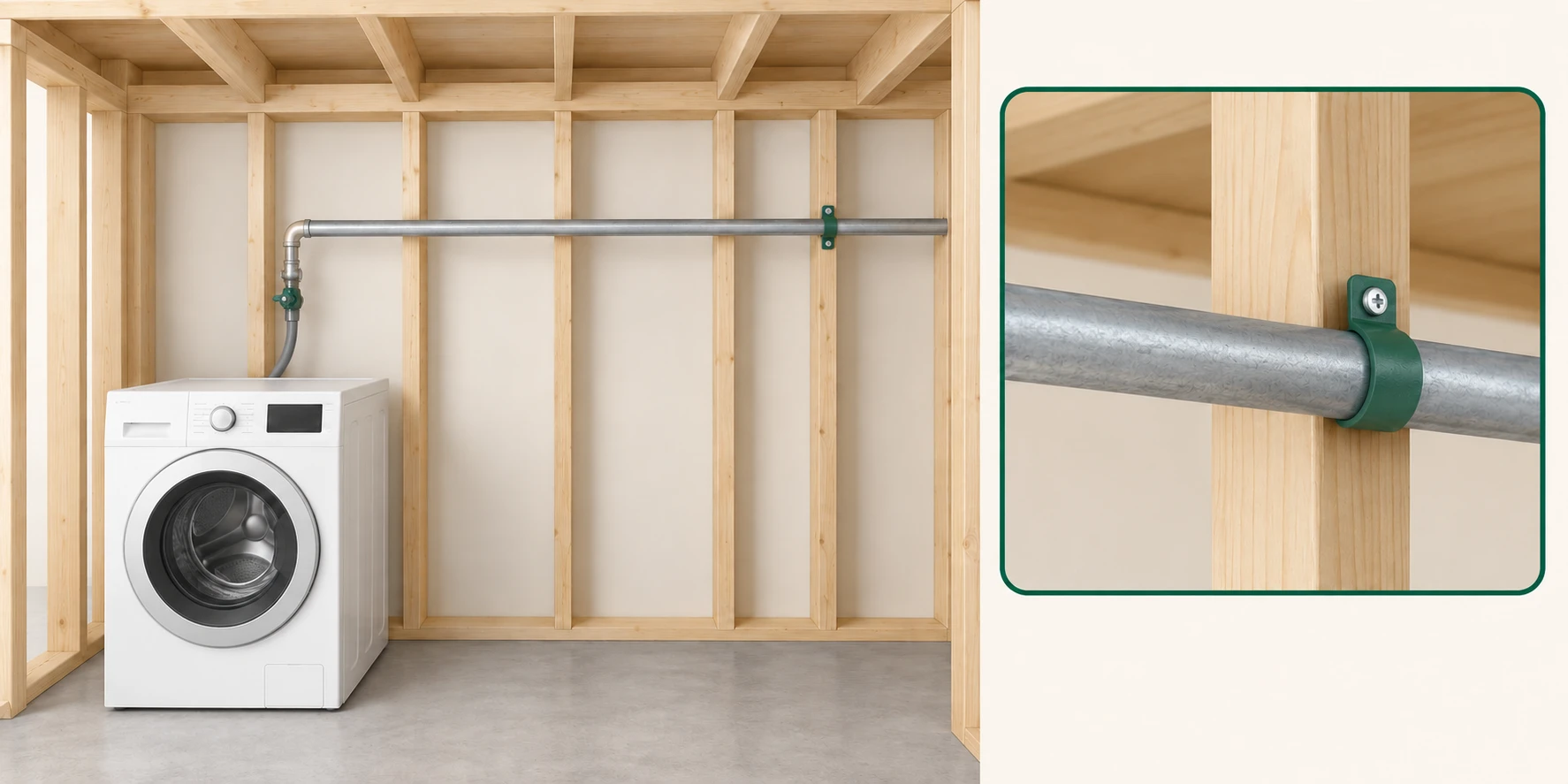
- Appliance event
Record when normal filling or flow changes. The event’s timing helps frame the investigation.
- Connected supply route
The sound may be heard somewhere along the connected system. Its loudest location does not identify the cause.
- Pipe support
A support holds the pipe near the framing. A professional can investigate movement or contact where the evidence warrants it.
What does this illustration leave out?
The still picture shows no pressure event, vibration, audible contact, loose support or confirmed cause. The illustrated branch is not a complete washer installation plan. Observe only during normal safe use. Do not provoke a bang, pull the pipe, alter the support or open the appliance.
Does the sound occur as filling stops, and what connects that event to the place where the noise is heard?
Explore this with HomeAI ↗Opens an editable question. Nothing is sent until you choose to send it.Which other noises require a different question?
Describe the pattern in everyday terms. Is it one thump when filling stops, a buzz while water runs, a click during warming or a drain sound after water is released? Each pattern gives the professional a different starting question. Timing is useful information, not a homeowner diagnosis.
Temperature-related movement is one alternative. Caleffi’s hydronic-heating article discusses allowing expansion and contraction without unwanted noise or stress. It also describes chatter in a particular heating-valve arrangement. Those examples explain why a heating sound deserves the relevant equipment assessment; they do not identify a supply-plumbing fault in this home.
An appliance’s moving parts, a valve-related sound during flow or contact with building materials may also enter the investigation. Ask which route and event the provider suspects, why, and what would distinguish another explanation. Keep an uncertain source uncertain rather than declaring the loudest location to be the origin.
Bring relevant appliance or heating-equipment details to the appointment. A water-based heating loop, municipal supply and private-well pump have different operating contexts. Do not adjust their controls or repeat unusual cycles to sort them out yourself. An initial visit can reasonably identify the next investigation instead of a finished cause.
What can I record safely during normal use?
Keep a short normal-use log: date, fixture or appliance, hot or cold water if known, whether filling was starting or stopping, simultaneous household use and where the sound was heard. Add recent plumbing, appliance or building work. Quiet ordinary cycles matter too, especially when the noise is intermittent.
If safe, retain a brief audio or video clip from an ordinary activity. Describe the actual moment, such as washer filling stopped, rather than writing confirmed water hammer. Keep the equipment model and available manual alongside it. The useful record connects the sound to a real sequence.
Do not slam valves, repeatedly provoke a bang, throttle service valves, open walls or touch hot pipework to improve the log. No new owner test is needed to make the record useful. If you cannot safely capture the event, say so and bring the information already available.
Where ordinary operation is accompanied by leakage, strong movement or another concerning change, stop trying to observe it and request appropriate service advice. Report the change plainly. A professional can plan the assessment without requiring the household to recreate a potentially damaging event.
What can a pressure measurement establish?
First ask what the measurement is meant to describe. A reading while no fixtures run describes one operating condition. A reading during sustained flow describes another. A brief pressure disturbance needs a method that can capture the relevant event. A steady reading taken afterward cannot establish a peak that was not captured.
Ask what the instrument recorded, where it was connected, which activity occurred and what period it covered. An actual report needs its value and units, method and relevant conditions. If a maximum is reported, ask how it was captured and which event or other condition it represents.
The measurement picture compares information tasks, not invented pressure traces. Sound loudness, a generic gauge drawing or a product label supplies no measured pressure. A provider should explain why the chosen method can answer the question and what its location or recording limits leave unresolved.
Calgary explains local pressure zones and inside-home equipment in its pressure guidance. Those examples do not set one national pressure value or tell you to adjust a regulator. Ask whether the actual evidence calls for supply assessment, event capture, appliance checks or a combination, with each result’s limits written down.
The method must match the pressure question
The cards explain what each information task can contribute to a noise investigation.
Numbers identify the parts explained below.
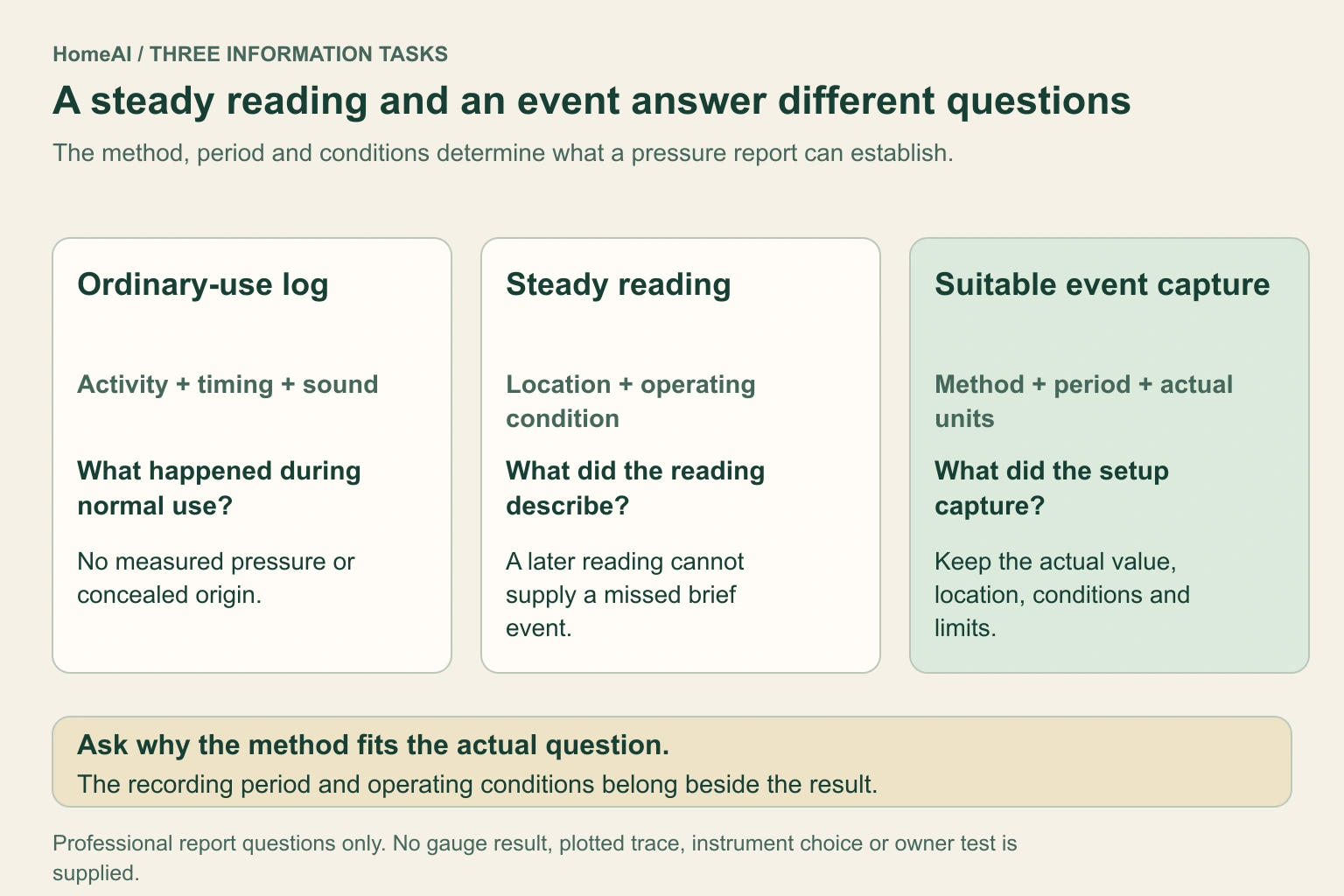
- Ordinary-use log
Record the activity, timing and sound from safe ordinary use. A log supplies no measured pressure or concealed origin.
- Steady reading
A reading describes its location and operating condition. A later steady reading cannot establish a brief event that was not captured.
- Suitable event capture
The professional’s method must capture the relevant period. Retain the actual value, units, location, method and conditions, with interpretation and limits.
What does this illustration leave out?
No actual pressure is recorded here. Ask what the chosen instrument, setup and period can establish and what they leave unresolved. Professional report questions only. Ordinary observations do not require a pressure experiment or new owner-operated test.
Does the report’s method and recording period answer the event question I brought to the visit?
Explore this with HomeAI ↗Opens an editable question. Nothing is sent until you choose to send it.Read the complete picture lesson
The method must match the pressure question
A sound log, a steady reading and a captured pressure event answer different questions. The report must identify what the method recorded, where and under which conditions.
- Ordinary-use log
- Record the activity, timing and sound from safe ordinary use. A log supplies no measured pressure or concealed origin.
- Steady reading
- A reading describes its location and operating condition. A later steady reading cannot establish a brief event that was not captured.
- Suitable event capture
- The professional’s method must capture the relevant period. Retain the actual value, units, location, method and conditions, with interpretation and limits.
For an actual measurement, retain its value and units, instrument or method, location, period and relevant operating conditions. Ask how a reported maximum was captured and why it is relevant. A conceptual drawing or later steady reading cannot supply the missing event.
What remains unknown: No measured pressure, instrument selection, diagnosis, national setting or owner test is supplied.
Useful next question: Does the report’s method and recording period answer the event question I brought to the visit?
Ask what the measurement actually covers
- Normal-use sound logConnects an audible event with a household sequence. · Supplies no measured pressure or hidden origin.
- Steady pressure readingDescribes the recorded location and operating condition. · Does not establish an uncaptured brief event.
- Suitable event captureRecords the relevant period under a stated method. · Needs actual location, units, conditions and interpretation.
Why is an arrestor not an automatic diagnosis?
A water-hammer arrestor contains a compressible cushion separated from the water. Sioux Chief explains that the air cushion compresses during a pressure surge and takes up surge energy. The separated cushion is the mechanism. A cylinder’s appearance does not identify the installed product, condition or appropriate application.
That device has a specific job. It does not explain every pipe sound or make support, valve and supply-pressure questions disappear. Before comparing proposals, ask which finding the arrestor is intended to address and whether the assessment established a relevant event in that connected route.
If the proposal also includes support or contact work, ask what each task does. Changes to an audible contact address a mechanical question; pressure regulation addresses a different equipment question. Keep the reasons separate so several proposed parts do not become a vague promise that every noise will vanish.
The qualified provider must establish selection, sizing, location, compatibility and installation under the actual product and local requirements. Our cutaway names the separated cushion; it supplies no dimensions, approved installation spot or retrofit procedure. Ask for the rationale, access needs, completed work record and agreed ordinary-use follow-up.
What is the air cushion’s job?
Water and the upper air space occupy separate chambers. The disk between them introduces the separated-cushion concept.
Numbers identify the parts explained below.
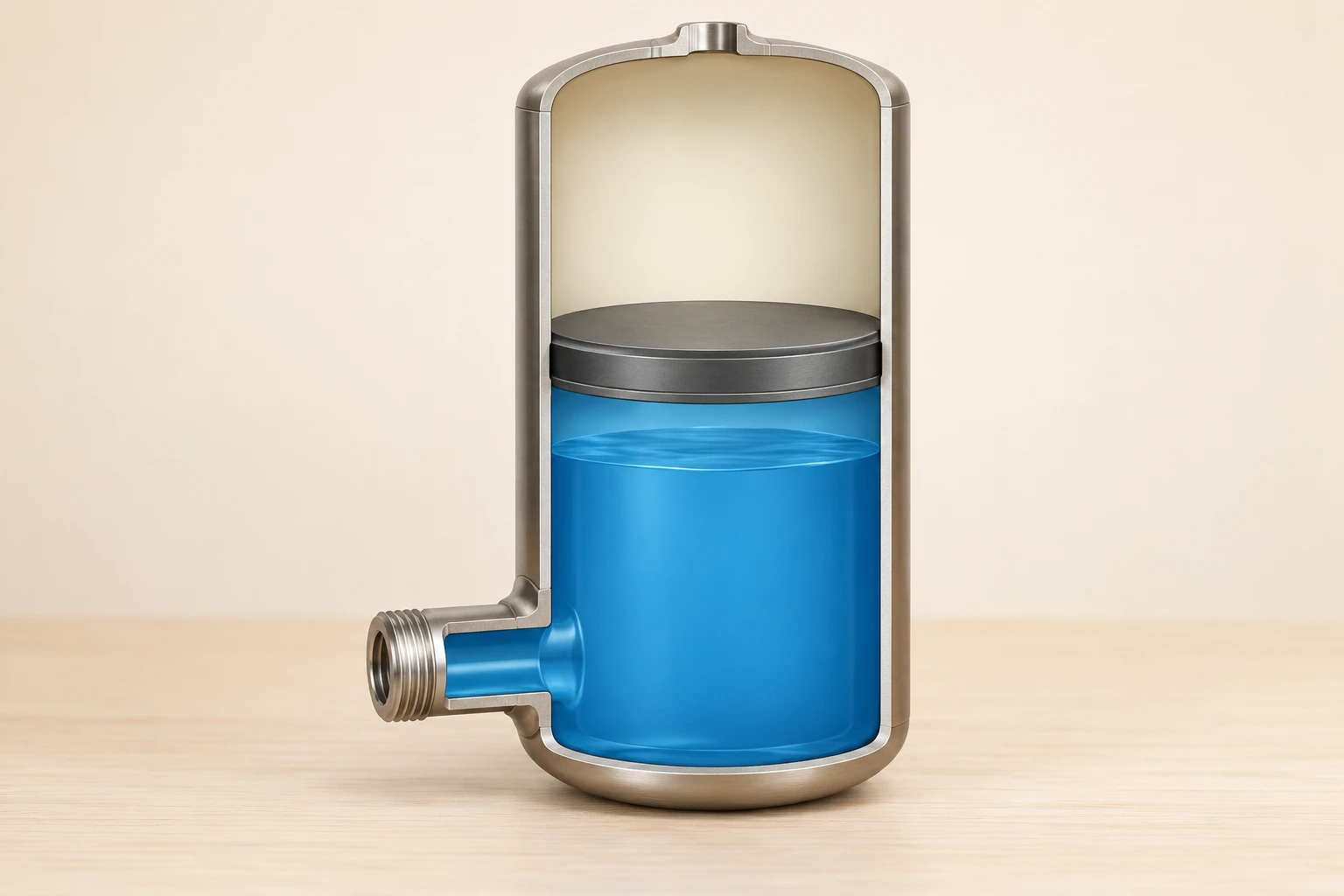
- Water chamber
The lower chamber represents water on the connected side of the device.
- Separating element
The separator keeps the water and compressible cushion apart in this generic concept.
- Enclosed air cushion
The cushion can compress during a pressure change. The actual product and application need their own instructions and assessment.
What does this illustration leave out?
This simplified picture gives no product identity, dimensions, pressure, motion measurement or approved installation. It does not establish that this home needs an arrestor. Selection, sizing, location, compatibility and installation belong to the qualified provider and actual product instructions.
Why does the provider expect the proposed arrestor to address the finding, and what will the follow-up check?
Explore this with HomeAI ↗Opens an editable question. Nothing is sent until you choose to send it.What changes with the municipality or a shared building?
Local requirements affect the proposed work. Calgary’s current permit page distinguishes constructing, extending or altering plumbing from named repair exceptions. It does not classify an unknown arrestor or support job for this article. Give the provider or authority the actual scope and confirm the applicable permit, inspection and qualification requirements.
In a shared building, the route or heating equipment may extend beyond the dwelling. Ask the manager which parts are common, who can authorise access and what records exist. Hearing a noise inside one unit does not establish permission to alter a shared valve, pipe or support.
A private-well arrangement introduces pumping equipment and its operating sequence. Identify the actual system and bring those questions to the appropriate qualified provider. A municipal supply sketch leaves those parts out. Likewise, the US manufacturer heating example is a mechanism reference, not a Canadian installation rule.
If a HAUSE-connected team helps coordinate the visit, ask about its actual training, licence, technical scope and local availability. Coordination can organise useful records and introductions. The relevant qualified provider and authority still determine their own findings and requirements; the guide does not promise an available specialist or approval.
How should a service visit and follow-up resolve the question?
In this fictional example, Sam notices a thump after a replacement washer stops filling. A visible supply section appears to move near a joist during ordinary use. Sam records the timing. The observations raise valve-event and contact questions; they do not establish a failed valve, excessive pressure or hidden damage.
Sam requests a visit covering the actual appliance, accessible route and any measurement the plumber considers appropriate. The written finding should say what was observed and what remained uncertain. If the sound does not occur safely during the visit, that absence is retained rather than replaced by a guessed cause.
A proposal then needs a reason for each task and a follow-up method. Sam asks which finding the work addresses, what will be checked, what access is needed and what remains outside the assignment. No pressure value, repair price or successful installation is invented for this teaching example.
After actual work, retain the invoice, identified parts, report and ordinary-use observations under comparable recorded conditions. A quieter cycle is useful information about the outcome; it is not an inspection of all concealed pipework. The follow-up should make the change and any remaining question understandable to the next provider.
Keep a finding, a proposal and an outcome separate
- FindingWhat did the visit establish, and what remained uncertain? · Every hidden pipe or cause was examined.
- ProposalWhich task addresses which actual finding? · An arrestor or support is automatically the answer.
- Follow-upWhat changed during comparable ordinary use? · A quieter cycle proves whole-system condition.
Practice the distinction.
Sam hears a thump when the washer stops filling
Fictional learning scenario: an intermittent thump is noticed during ordinary cycles after appliance replacement.
Reported observations
- The sound follows filling stopping during a recorded ordinary cycle.
- A safely visible supply section appears to move near a joist.
- Transient pressure and concealed supports remain unassessed.
Compare the explanations
Expand each possibility to see the evidence needed to distinguish it. Similar symptoms can have different mechanisms.
Pressure response to a valve event
The actual change in flow may create a relevant response in the connected supply route.
The plumber’s equipment/route assessment and any suitable event measurement.
Movement becoming audible at a contact
Contact or support may contribute to the sound, alone or alongside a hydraulic response.
An actual accessible observation with concealed areas left unresolved.
A useful next question
Provide the ordinary-use log and ask for finding-linked work and a stated follow-up method.
No actual pressure magnitude, defect, hidden damage, code breach or appropriate installation is established.
Know what the words mean.
- Momentum
- Motion carried by the mass of flowing water; a change in that motion requires force.
- Pressure transient
- A brief pressure response while an operating condition changes, distinct from a steady reading.
- Mechanical coupling
- Movement or vibration transferred between a pipe, supports and adjoining building materials.
- Water-hammer arrestor
- An engineered device with a compressible cushion separated from the water; suitability depends on the actual product and system.
- Event capture
- A recording or measurement that preserves the relevant event and states its place, period and limits.
Questions to bring
to the conversation.
- What ordinary activity happened just before the sound?
- Which pipe route and equipment were actually identified?
- Was a pressure event, audible contact or another cause established?
- What method, units, conditions and follow-up explain the proposed work?
Separate a showing observation, an existing record and a new professional assessment. Unknown means a question remains; it does not automatically mean a defect.
Use the evidence planner ↗Go to the source.
Original HomeAI explanation informed by these public references. Sources support the underlying guidance; they have not reviewed or endorsed HomeAI. Diagrams are conceptual, and calculator outputs depend on your inputs.
Concepts reviewed for this refresh on October 5, 2026. Hayward, Sioux Chief and Caleffi explain their stated physical or equipment context; they do not approve a Canadian installation. Calgary pressure and permit examples are municipal. The figures contain no measured pressure trace, national setting or owner test procedure.
Publication & source review
First published .
Sources reviewed .
Have a question about your home?
Start with the symptom, timing and what you have observed.
Ask HomeAI