- The amount due and the energy quantity answer different questions.
- Keep the energy unit, consumption dates, day count and reading status together.
- A daily average handles unequal period length while leaving weather and household context unresolved.
- Billing, building-energy and equipment questions need different scopes.
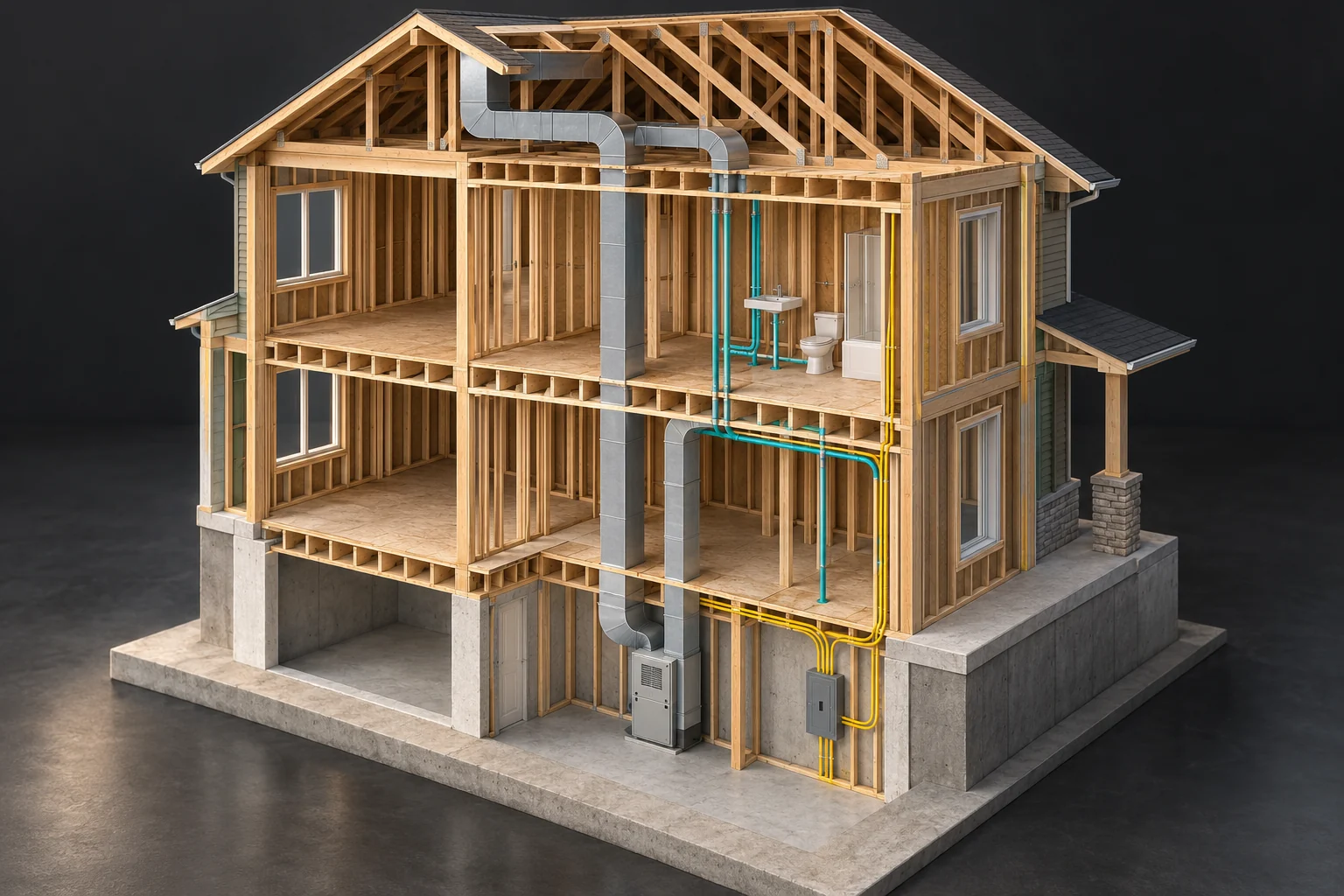
Conceptual architecture. Layout, sizes and routes are illustrative; the picture does not describe your home’s condition.
Explore this in the visual atlas ↗2 picture lessons appear beside the questions in this guide. Use them to understand the explanation, then consider what it means for your home.
Why can the amount due increase without the same increase in energy?
An energy bill tells two stories: the energy recorded for a period and the money calculated on the account. Find the energy quantity and its unit before interpreting a higher payment. Keep the amount due in dollars in a separate field.
The amount due may include a previous balance, payments, adjustments, service charges and taxes alongside the current energy charge. BC Hydro lists rate changes and payment-plan adjustments as possible reasons for a higher bill. FortisBC separately explains account balances and basic, delivery and commodity charges on its gas bill.
These are British Columbia provider examples, not a national price or billing policy. Ask your provider to explain the categories on your actual bill. A higher dollar amount does not, by itself, show more energy use or a failing furnace.
In a useful log, write “amount due changed” and “billed energy changed” as separate entries. The first raises an account question. The second raises a consumption question that still needs dates, read status and household context.
Read the account amount and energy record separately
The left card explains account money; the right card lists the information needed to interpret the physical energy quantity.
Numbers identify the parts explained below.
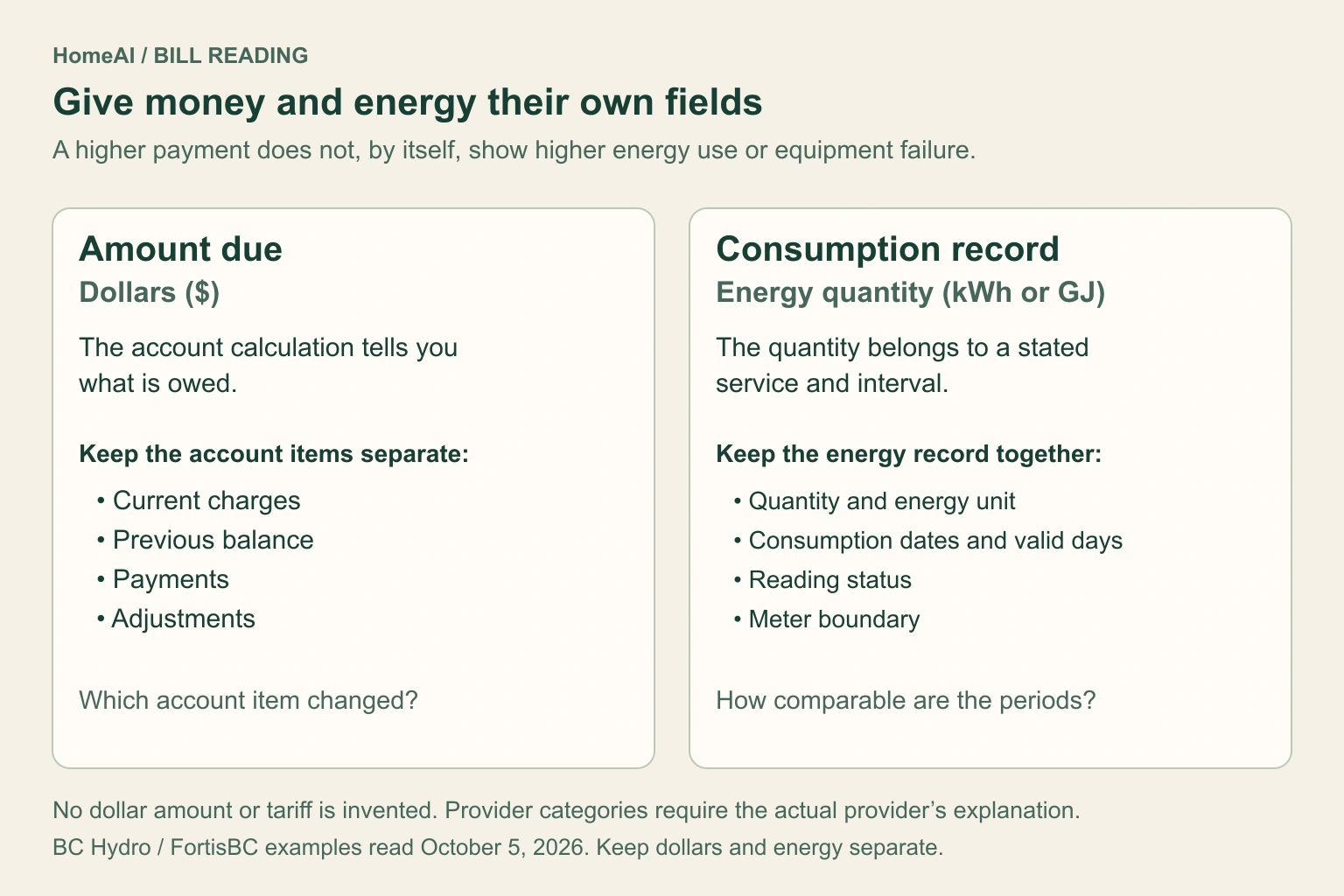
- Amount due — dollars ($)
The account calculation tells you what is owed. Keep current charges, previous balance, payments and adjustments separate. Read the actual provider’s explanation. Next question: Which account item changed? The fictional example supplies no dollar amount or tariff.
- Consumption record — energy
The quantity describes the recorded energy for a stated interval. Keep the quantity, energy unit (kWh or GJ), consumption dates, valid period days, read status and meter boundary together. Next question: How comparable are the two periods? Do not convert dollars to energy or gas volume to GJ with an assumed factor.
What does this illustration leave out?
The categories organize a bill; they are not an actual customer account or national tariff. Ask the actual provider about its charges, units and period. BC Hydro and FortisBC examples were read October 5, 2026; provider-specific rates and policies are not adopted.
Did an account charge change, did the recorded energy change, or do both questions need explaining?
Explore this with HomeAI ↗Opens an editable question. Nothing is sent until you choose to send it.Give the amount due and consumption record their own fields.
The categories below help read the actual provider’s bill. They are not a customer record or a national tariff.
- Amount due — dollars ($)
- The account calculation tells you what is owed.
- Keep: Keep current charges, previous balance, payments and adjustments separate. Read the actual provider’s explanation.
- Next question: Which account item changed? The fictional example supplies no dollar amount or tariff.
- Consumption record — energy
- The quantity describes the recorded energy for a stated interval.
- Keep: Keep the quantity, energy unit (kWh or GJ), consumption dates, valid period days, read status and meter boundary together.
- Next question: How comparable are the two periods? Do not convert dollars to energy or gas volume to GJ with an assumed factor.
The provider examples are BC Hydro and FortisBC, read October 5, 2026. Their actual categories require the provider’s explanation; no price, tax rate, payment-policy advice, volume conversion or equipment finding is supplied. Keep dollars and energy separate.
What do kWh, kW, GJ and cubic metres mean?
A kilowatt-hour, or kWh, is an amount of electrical energy accumulated over time. A kilowatt, or kW, is a rate of energy use or supply. A monthly kWh total cannot reveal the highest simultaneous power demand or establish spare capacity for another appliance.
A gigajoule, or GJ, is another energy unit. A cubic metre is a volume unit. FortisBC’s gas-bill explanation describes converting its recorded gas volume to GJ using the applicable billing factor. Preserve the provider’s actual units and conversion information; do not assume a generic factor.
Compare quantities already expressed in the same energy unit. The worksheet accepts kWh or GJ for that purpose. It does not convert fuel volume, combine fuels or calculate heat delivered to rooms. If a unit is unknown or differs between records, resolve it before interpreting the subtraction.
Which dates actually define the consumption period?
The consumption period tells you when the recorded energy belongs. The issue date tells you when the bill was produced. The due date tells you when payment is required. Those dates have different jobs.
Keep the consumption start and end dates and the provider’s stated day count with the energy quantity. FortisBC distinguishes these date fields, and BC Hydro explains that a longer period can raise the total. Two bills issued a month apart need not cover equal numbers of days.
Mark moves, incomplete first bills, account changes and any overlapping or missing periods. A bill issued after a renovation may still include earlier use. Ask the provider about an unclear interval rather than assuming the payment month is the observation period.
How do I compare billing periods with unequal numbers of days?
Divide each energy quantity by its own valid period days. In the fictional comparison, 600 kWh over 30 days gives 20 kWh/day. A later 700 kWh over 35 days also gives 20 kWh/day. More total energy over more days can therefore have the same calculated daily average.
The worksheet compares those entered averages and keeps the read-status labels alongside them. An empty quantity remains unknown. A recorded zero energy quantity can be valid, but zero or negative days cannot define an average. Percentage change from a zero baseline is undefined.
Averaging fixes the unequal-length arithmetic only. It does not adjust weather, occupancy, estimated readings or a changed meter boundary. An average also hides the timing of peaks and quieter days.
The illustrated quantities are invented teaching inputs, not a Canadian consumption benchmark. The result measures no appliance efficiency, attributed repair saving or future bill cost.
A larger total can have the same daily average
The total-energy and period-length panels are higher for B. The daily-average panel has equal bars at 20 kWh/day.
Numbers identify the parts explained below.
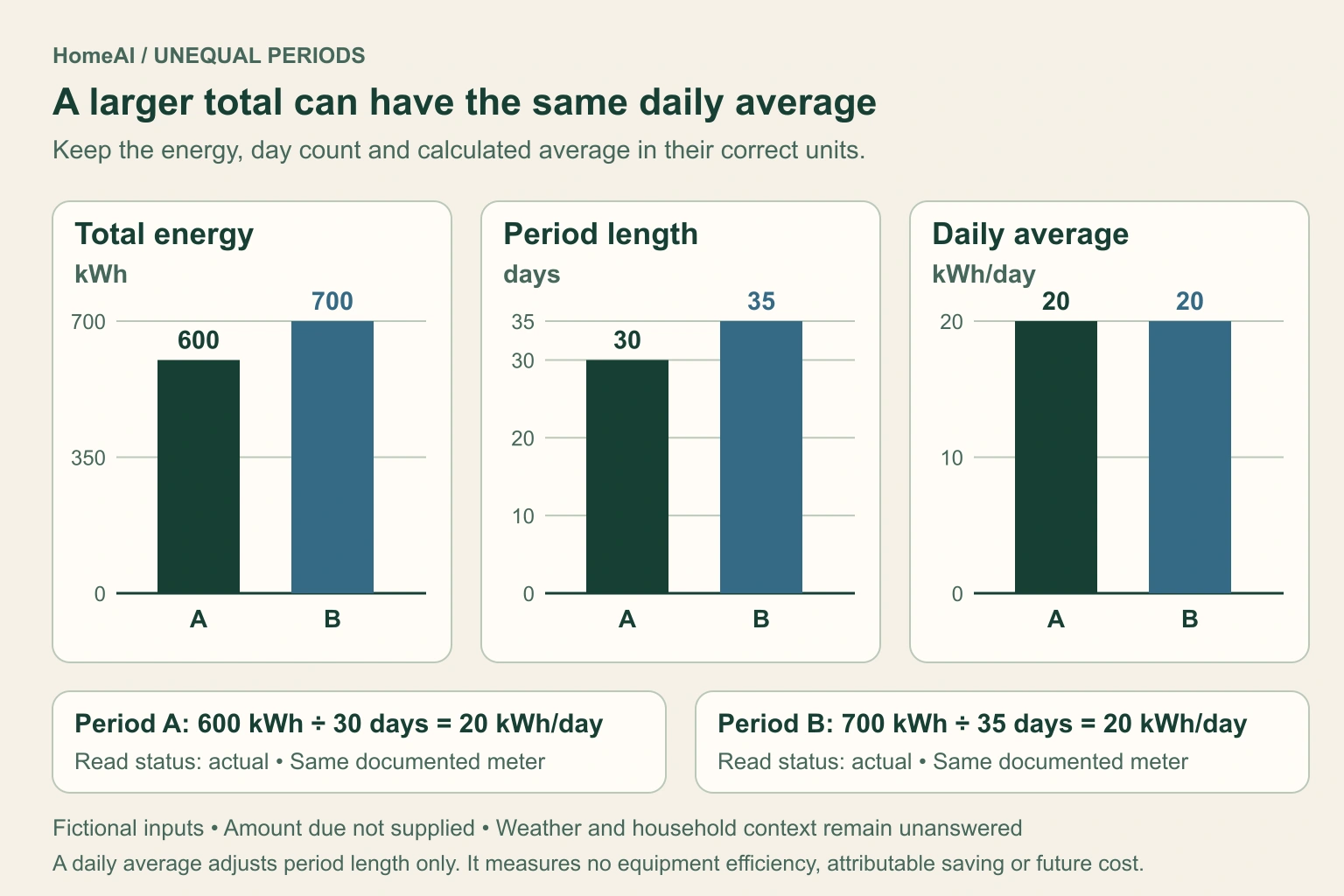
- Period A
600 kWh over 30 days gives 20 kWh/day. Read status: actual; amount due: not supplied.
- Period B
700 kWh over 35 days gives 20 kWh/day. Read status: actual; amount due: not supplied.
What does this illustration leave out?
Both fictional reads are actual and cover the same documented meter. Amount due is not supplied. Weather, household changes, equipment condition, savings and future cost remain unresolved. Original fictional arithmetic:600 kWh÷30 days=20 kWh/day;700 kWh÷35 days=20 kWh/day. This is not a Canadian household benchmark.
Are period lengths the only difference, or do readings, weather, household use and meter boundaries need reconciliation?
Explore this with HomeAI ↗Opens an editable question. Nothing is sent until you choose to send it.Keep totals, days and daily averages separate.
The chart uses three separate panels: energy quantity in kWh, period length in days and calculated energy per day in kWh/day. All values below are invented parts of the worked example.
- Period A
- Energy: 600 kWh. Length: 30 days.
- Average: 600 kWh ÷ 30 days = 20 kWh/day.
- Read status: actual. Meter: the same documented boundary in both periods. Amount due: not supplied.
- Period B
- Energy: 700 kWh. Length: 35 days.
- Average: 700 kWh ÷ 35 days = 20 kWh/day.
- Read status: actual. Meter: the same documented boundary in both periods. Amount due: not supplied.
The arithmetic difference between the averages is 0 kWh/day. B has 100 kWh more energy over 5 more days. These facts reconcile period-length arithmetic; they do not isolate a repair, weather or household change.
Weather and household context remain unanswered. No tariff, measured Canadian consumption data, appliance efficiency, attributable saving or future bill cost is supplied. Both actual read labels describe the fictional record status, not a controlled equipment test.
How can an estimated or corrected reading change the story?
Read status explains how the provider established the quantity. If a scheduled reading was unavailable, an estimated bill may be followed by an actual reading that reconciles earlier over- or underestimation. BC Hydro and FortisBC both explain this possibility.
Keep estimated, actual, corrected or unknown beside the entry. An actual reading answers the reading-status question; weather and other comparison assumptions still need attention. For a correction, retain the original and revised records and ask which interval was affected.
A catch-up bill may need to be understood with the earlier periods rather than interpreted alone. Let the provider reconcile the dates and quantities. The worksheet does not perform that work, and changing its status label does not turn an uncertain input into an equipment measurement.
Reading status is part of the record
- ActualThe provider reports an actual reading. Other period, boundary and context questions still apply.
- EstimatedKeep the estimate label and ask how a later actual reading reconciles the affected periods.
- CorrectedRetain both records and identify the quantity and interval the correction changes.
- UnknownLeave status unknown until the provider or record explains it. A worksheet selection does not establish a reading.
What weather context should accompany the energy record?
Heating and cooling needs can change with the weather. Match the energy period to a named weather source and its dates. Note whether you used actual station observations or a longer-term climate summary; a station is context for the home, not an indoor sensor.
ECCC’s climate glossary defines heating and cooling degree-days using an 18°C base. These indicators add temperature departures over time. That stated base is not an established balance point for this particular house.
Degree-days do not measure delivered heat, equipment runtime or every effect of wind, sun and moisture. Other household loads also use energy. Dividing the entire bill by a degree-day total therefore cannot establish furnace efficiency.
A professional analysis may use a suitable method and clearly defined loads. This lesson supplies no numerical weather correction, forecast or measured local weather series.
Which household changes can overwhelm a simple before-and-after comparison?
Record ordinary changes that affect demand: occupants, visitors, time at home, thermostat schedules, laundry, hot water, renovations and added appliances. Approximate dates are useful when exact dates are unavailable. The purpose is to explain context, not monitor every household activity.
Changing fuels can move a load between accounts. After replacing gas heating with a heat pump, a higher electricity quantity cannot alone establish higher total household energy use. The gas record and other affected services also matter.
A vacant period, a new vehicle charger or several simultaneous changes can overwhelm a simple repair comparison. Keep those possibilities visible and ask what could distinguish them. Do not attribute the entire difference between bills to one installation.
What does the meter boundary leave outside the comparison?
A meter boundary means the service and connected loads represented by a record. An apartment’s electricity bill may exclude shared building heat. A separate meter, delivered fuel, central boiler or generation system can require additional records.
For solar or storage, ask what each number represents: energy imported from the grid, exported to it, generated on site or recorded as a stated net value. The actual metering arrangement matters. A payment credit is money; it is not itself a physical generation measurement.
Use the same documented boundary for both periods or state how it changed. Zero net billed energy does not establish zero gross household demand. Keep account and meter identifiers in your private file, while sharing only the broad technical question in public chat.
Why will an EnerGuide rating differ from the utility bills?
An EnerGuide rating describes modelled annual performance using standard operating conditions. Utility bills record household consumption and account information for their actual periods. Similar energy units do not make those methods interchangeable.
NRCan explains that standard thermostat, hot-water and occupancy assumptions allow comparison between houses. Actual weather, household fluctuations and atypical loads can differ. Keep the label, Homeowner Information Sheet and Renovation Upgrade Report together to understand the model’s scope.
For upgrade planning, an NRCan-registered energy advisor works through the selected service organization. Ask about the evaluation’s assumptions and outputs, and bring the relevant period log. Building-energy evaluation, appliance service and billing reconciliation answer different questions. No rebate or programme eligibility is established here.
What does a fictional higher-total, unchanged-average case teach?
Rowan is a fictional owner comparing 600 kWh over 30 days with 700 kWh over 35 days. Both read statuses are actual and both records cover the same documented meter. Each average is 20 kWh/day; the arithmetic difference is zero.
Rowan recalls a colder later period and a visitor, but has not matched those dates to the records. Those remain possible explanations. The equal averages cannot isolate the effect of a recent heating service.
A continuing comfort concern needs its own room observations and appropriate equipment assessment. The bill comparison supplies no actual Canadian household data, tariff, weather-normalized saving or measured efficiency. Its useful result is a clearer question, with the missing context still visible.
Which next question belongs to the utility, advisor or equipment professional?
Ask the utility about units, dates, reading status, corrections and account charges. Ask an energy advisor about building performance and proposed upgrades. Ask the appropriate equipment professional about a named appliance symptom, using its model and ordinary operating observations.
Request a finding tied to the original question and the assessed period or equipment. Keep completed work and agreed follow-up together. A smaller next payment alone cannot verify that an equipment problem was resolved.
Use safely available paperwork and ordinary observations. Do not open a meter or panel, handle utility seals, alter gas controls or force equipment into a test to separate consumption. HomeAI can help organize the question and a separately consented HAUSE request without an account number or home address in chat.
If a CO alarm sounds or you suspect CO exposure, leave immediately for fresh air. Do not search for the source. Call 911 or emergency services from outside, remain outside and follow responders’ re-entry instructions.
If you smell gas or suspect a gas leak, leave without using a phone indoors, operating electrical switches or creating ignition sources. Call the applicable gas emergency line or 911 from outside. For smoke or fire, stay clear and seek emergency help. These situations take priority over bill investigation; do not wait for chat advice.
Keep learning about the connected parts
Three questions, three useful starting points
- Utility or billing providerWhat do the quantities, units, period, status and account adjustments mean?
- Building-energy advisorWhich building changes could address the stated performance goal, under which model and assumptions?
- Equipment service professionalWhat explains the named appliance symptom and what assessment or follow-up answers it?
Practice the distinction.
Rowan compares two unequal periods
Fictional learning scenario: the later electricity record has more energy and more days; weather and household context are still unresolved.
Reported observations
- Period A:600 kWh over 30 days; period B:700 kWh over 35 days.
- Both provider read statuses are actual in the invented example.
- Both cover the same documented meter.
- Each calculated average is 20 kWh/day; the amount due is not supplied.
Compare the explanations
Expand each possibility to see the evidence needed to distinguish it. Similar symptoms can have different mechanisms.
The daily arithmetic is equal
600 ÷ 30 and 700 ÷ 35 each give 20 kWh/day, even though the totals differ.
The invented energy quantities, valid days and arithmetic.
Repair attribution remains open
The averages do not isolate weather, visitors or the recent heating service.
Relevant dated context and an assessment suited to the actual question.
A useful next question
Keep quantities, dates and reading status together, then choose the billing, building or equipment question that remains.
No real consumption dataset, tariff, weather correction, measured efficiency or future-cost guarantee is supplied.
Know what the words mean.
- Billing period
- The stated interval associated with a billed quantity or charge, separate from the issue and payment due dates.
- Energy quantity
- An accumulated amount in a stated energy unit, such as kWh or GJ; money, power and fuel volume have different units.
- Period average
- The entered energy quantity divided by its valid day count, without an automatic correction for other conditions.
- Meter boundary
- The service and connected loads represented by the record; shared systems or other fuels may fall outside it.
- Degree-day context
- A temperature-and-time indicator using a stated base. It provides context for demand rather than measuring equipment efficiency.
Questions to bring
to the conversation.
- What energy unit and service does each quantity represent?
- Which consumption dates and valid day counts belong to it?
- Are the reads actual, estimated, corrected or unknown?
- Which weather, household, equipment or fuel changes affect the comparison?
- Do shared systems, other fuels or generation require separate records?
- Does the remaining question belong to the utility, energy advisor or equipment professional?
Separate a showing observation, an existing record and a new professional assessment. Unknown means a question remains; it does not automatically mean a defect.
Use the evidence planner ↗Go to the source.
Original HomeAI explanation informed by these public references. Sources support the underlying guidance; they have not reviewed or endorsed HomeAI. Diagrams are conceptual, and calculator outputs depend on your inputs.
Chapter references reviewed for this refresh on October 5, 2026. BC Hydro and FortisBC billing examples apply locally. ECCC defines climate quantities; this guide supplies no weather-normalized home result. EnerGuide uses standard modelled operating assumptions. Keep actual bill periods, units, read status and household context.
Publication & source review
First published .
Sources reviewed .
- BC Hydro · Looking into a high bill
Where this reference applies
Jurisdiction: BC Hydro customer billing, British Columbia
Period length, estimated/catch-up reads, rates/payment-plan adjustments and household/weather alternatives. No breaker test, tariff advice, rebate eligibility or savings promise is reproduced.
- BC Hydro · Energy concepts, explained
Where this reference applies
Jurisdiction: BC Hydro education, British Columbia
Consumption in kWh versus power demand in kW and multiple energy sources. No typical-house benchmark, generation-efficiency comparison, rate forecast or emissions factor is reproduced.
- FortisBC · How to read your natural gas bill
Where this reference applies
Jurisdiction: FortisBC customer gas billing, British Columbia
Consumption/issue/due-date distinctions, volume-to-GJ billing conversion, estimated-read reconciliation and separate account charges. No generic conversion factor, price, tax rate, blended-fuel percentage or payment-policy advice.
- Environment and Climate Change Canada · Climate glossary
Where this reference applies
Jurisdiction: Canadian federal climate definitions
Modified August 10, 2026. Degree-days with an 18°C base and station/data provenance definitions. No current local weather series, numeric weather normalization, building balance-point assumption or forecast is supplied.
- NRCan · After your EnerGuide home evaluation
Where this reference applies
Jurisdiction: Canada; EnerGuide evaluation interpretation
Modified November 28, 2025. Modelled annual rating versus household bills, standard operating assumptions, report outputs and atypical-load/weather limits. No actual household saving or incentive eligibility.
- NRCan · EnerGuide energy efficiency home evaluations
Where this reference applies
Jurisdiction: Canada; EnerGuide programme assessment scope
Modified December 23, 2024. NRCan-registered energy advisor, service organization, stated evaluation scope and collected building information. No owner blower-door, gas-control, unsafe-access or preparation procedure is reproduced.
- Health Canada · Carbon monoxide: preventing exposure
Where this reference applies
Jurisdiction: Canada
Modified November 12, 2024. CO-alarm evacuation, emergency call from outside, professional re-entry boundary and seasonal exhaust-obstruction context. No owner combustion testing or exhaustive provincial alarm-law claim.
- Public Health Agency of Canada · Poisonings and injuries related to carbon monoxide exposure
Where this reference applies
Jurisdiction: Canada; federal public-health emergency response
Modified August 24, 2023; full article freshly read. Used solely for immediate evacuation/fresh air, 911 and responder-authorized re-entry when CO exposure is suspected. No diagnostic symptom rule, exposure concentration, national incidence extrapolation, installation rule or maintenance interval is reproduced.
- FortisBC · Gas leaks and odour
Where this reference applies
Jurisdiction: FortisBC gas service area, British Columbia
Leave suspected gas without using indoor phones or electrical switches or creating ignition; call the applicable utility/emergency services from outside. FortisBC contacts remain local examples, rather than a Canada-wide utility number.
Have a question about your home?
Start with the symptom, timing and what you have observed.
Ask HomeAI